Sayuri
Memoirs of a GeishaSayuri is the geisha name of Sakamoto Chiyo, a fisherman's daughter from Yoroido whose life was redirected from a small town on the Sea of Japan into Gion's demanding world. Looking back from old age, she frames her story around the afternoon she met Mr. Tanaka Ichiro: it was, she says, the best and worst of her life, because his intervention set her on the path to becoming a geisha while separating her from home. Her eventual life with the Chairman fulfills a long-held hope, but the retrospective voice that tells it also insists that love, loss, and identity remain inseparable from the chance events that carried her there.
Identity and Origins
Before she became Sayuri, she was Sakamoto Chiyo, the younger daughter of a fisherman in Yoroido. She stresses that she was neither born in Kyoto nor raised for a geisha career. Her family and childhood home were subjects she had shared with very few people, in part because outsiders preferred the romantic fiction that a geisha must have been born into the profession and trained from infancy. The truth of her origins is less ornamental: she came from a fishing village, with parents and an older sister, and her life in Gion began through separation rather than inheritance.
The adult narrator makes that concealed past visible through a scene of recognition. Years later, while pouring sake, she learned that a man had recently visited Yoroido and blurted out that it was where she grew up. She compares the shock to a bird crossing an ocean and suddenly encountering someone who knows its nest. The image gives her home a lasting emotional force: even after decades away, the village remains a place of origin that can break through the guarded story she has learned to tell.
Her name records the transformation without erasing the person who preceded it. As a child she was Chiyo; after entering the Nitta household, she became Sayuri, and following her adoption her full name became Nitta Sayuri. The narrative repeatedly returns to the difference between these identities, not as a simple replacement but as a life accumulated in layers: the daughter from the sea cliffs remains present within the public figure shaped by Gion.
From Apprentice to Geisha
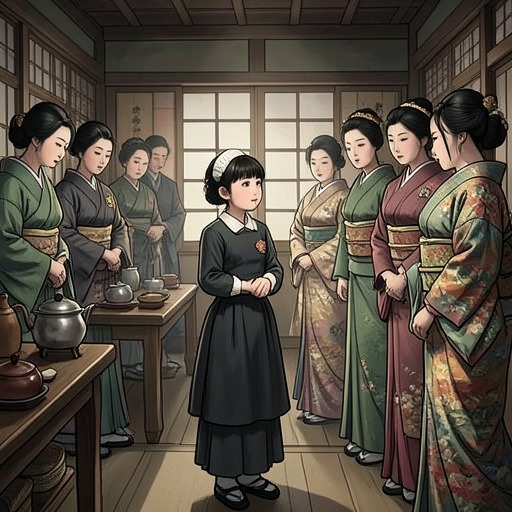
Sayuri's early career makes visible the material labor behind geisha elegance. She watches Hatsumomo being dressed as Mr. Bekku manages the heavy kimono and its elaborate obi, secured with cords, clasps, and padding. To the child looking on, the expensive brocade and plum-colored obi seem almost impossibly glamorous; the outfit's cost may equal a shopkeeper's or policeman's annual earnings. Such clothes are not merely decoration: they require specialist work, substantial resources, and the institutions of the okiya that preserve and circulate them.
That material world is also vulnerable. While storing kimono, Chiyo sees a loft lined with red lacquer cases, each holding garments wrapped in linen paper. Some contain perhaps fifteen kimono, and the collection is worth more than the villages of Yoroido and Senzuru combined. The storehouse explains Granny's fear of fire, while the most expensive garments are kept in a rented vault. From the beginning, the spectacle of geisha dress is paired with its economic weight and the precariousness of the wealth invested in it.
At her first banquet, Sayuri is a novice accompanying Mameha rather than an independent entertainer. The guests sit around a large tatami room, while geisha move through its center to pour sake and make conversation. Sayuri introduces herself with a formal request for indulgence, then remains mostly silent, following Mameha like a shadow. Near the end, Mameha and another geisha perform Chi-yo no Tomo, a dance about two devoted women meeting after a long absence. The business guests pay little attention, but Sayuri is captivated by Mameha's fan: in a turn of the body it suggests flowing water, then opens into a cup for the other dancer to fill with sake. The scene contrasts the audience's indifference with the young apprentice's intense attention to the art she hopes to inhabit.
Her public identity is contested as soon as she begins to enter Gion's social world. At a gathering, Hatsumomo asks her name and then invents the name Mayuri for a supposedly inexperienced novice in a story designed to humiliate her. Sayuri answers directly that her name is Sayuri, though nervousness makes her fear that her makeup might melt. The exchange shows how her new name can be used both as the foundation of a career and as a target in the rivalry that threatens it.
Her ascent is measured through two formal changes. In early July 1935, at fifteen, she undergoes mizuage in a ceremony at the Ichiriki Teahouse, binding herself to Dr. Crab as her patron. Mother, Auntie, Mameha, the teahouse mistress, and Mr. Bekku are present; Sayuri wears the apprentice's formal black robe with five crests and a red underrobe, the color of new beginnings. The ceremony has a public and institutional setting, and its economic consequence is decisive: the fee repays her okiya debts, but Mother adopts her the following week, making the okiya the recipient of her subsequent profits. Sayuri's name changes from Sakamoto Chiyo to Nitta Sayuri as the household claims her success as its own.
In the summer of 1938, at eighteen, she turns the collar and becomes a geisha rather than an apprentice. The red collar of the apprentice gives way to the white collar of the established geisha; the shift marks a change in status and in the kind of patronage available to her. For Mother, whose delight is inseparable from the prospect of money, the transition is cause for celebration. For Sayuri, it follows years of parties, study, and dance performances, and establishes her as a professional whose standing in Gion rests on both disciplined training and the reputation Mameha helped build.
Survival, Memory, and the Chairman
Wartime disruption exposes how much Sayuri's prewar standing depended on the resources and protection around her. After cosmetics and permanents are banned as luxuries by the military government, she moves her modest possessions across the okiya: scrolls, inkstones, bowls, books, magazines, and stereoscopic photographs viewed through a sterling-silver viewer given by the Kabuki actor Onoe Yoegoro XVII. Lavish gifts have become rare, and these few objects define what she has managed to keep. In December 1942, a military policeman arrives at the okiya and asks to speak to her after she is told Mother is out. The visit signals that even the household's exceptional protection has reached a turning point.
During her wartime refuge with the Arashino family, the distance between geisha display and physical survival becomes stark. By day, Sayuri helps sew parachutes; at night, she sleeps on futons in the workshop beside the family's daughter and grandson. With too little charcoal, they burn compressed leaves, newspapers, and magazines for warmth, and eat soybean dregs, fried rice bran, and whatever occasional potatoes, dried whale meat, seal sausage, or sardines they can obtain. Sayuri grows so thin that people from Gion would scarcely recognize her. The wartime phrase “onion life” captures the repeated deprivation: one layer is peeled away at a time, with tears accompanying each loss.
Adversity also strips away the elaborate purposes she once assigned to her life. Watching the Kamo River pass the workshop, Sayuri throws petals or straw into the current and imagines that a piece might travel to Osaka and somehow reach the Chairman. Yet she begins to question whether he would think of her if he saw it. He has been kind, but she cannot find evidence that he remembers the girl he once comforted or knows the depth of her attachment. The river image changes from an emblem of hope into a measure of distance: her longing may be carried toward him without ever arriving in his awareness.
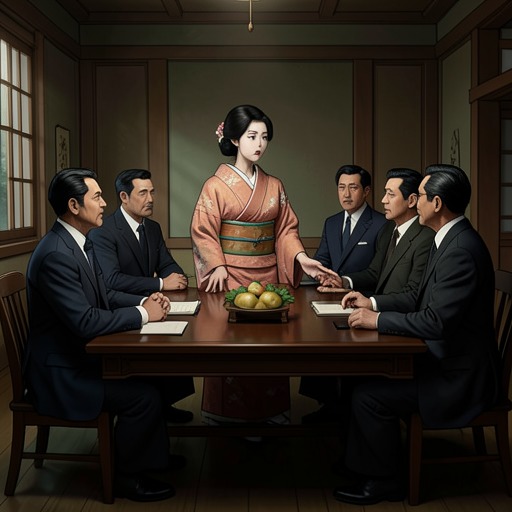
When Sayuri returns to Gion, hope still competes with obligation. She knows that her life may be falling toward Nobu, but she cannot surrender the possibility of reaching the Chairman. Her plan to end her bond with Nobu takes shape when she realizes that an encounter with the Minister, witnessed by Nobu, could provoke the anger that would make him reject her. She understands the cost: Nobu has been kind, and betraying his trust to preserve her hope would be a deliberate injury. The decision is not presented as uncomplicated romantic pursuit, but as a choice made within a constrained world where patronage, reputation, and personal desire pull against one another.
When Sayuri finally confesses to the Chairman, she tells him that her feelings for him have guided every step she has taken since childhood. He explains that when he saw her with the Minister, her desperate expression recalled the girl at the Shirakawa Stream; after learning from Pumpkin that the encounter had been arranged for Nobu to see, he told Nobu what he had witnessed. Nobu's angry response convinces the Chairman that Nobu was not truly Sayuri's destiny. The disclosure recasts their history: the Chairman had recognized her vulnerability and intervened, while her own long devotion had remained largely unspoken.
The Chairman becomes Sayuri's danna, and she describes the resulting life not as the end of all difficulty but as a profound easing after years of struggle. She imagines herself as a tree whose roots have finally reached rich, wet soil. At their sake ceremony at the Ichiriki Teahouse, a drop spills from her mouth and comes to rest on the silver threads of the dragon woven around the hem of her black, five-crested kimono. Rather than treating it as an omen, she sees in its uncontrolled fall and eventual resting place a figure for her life, and recalls the petals sent downriver from the Arashino workshop. Chance and direction, helplessness and arrival, remain bound together in the image.
New York and the Shape of the Past
Sayuri's life with the Chairman eventually extends beyond Gion. In August of the year she moves to New York City, she opens a small teahouse for Japanese businessmen and politicians traveling through the United States. Mother attempts to make the enterprise an extension of the Nitta okiya, but the Chairman refuses, and two of his accountants ensure that Mother gives Sayuri every yen to which she is entitled. Leaving Gion therefore changes more than her address: it breaks Mother's financial power over her and allows Sayuri to establish a livelihood outside the household that had claimed her earnings.
The teahouse is modestly successful, and Gion remains present in the community Sayuri builds abroad. Geisha from Gion come to work there, Mameha sometimes visits, and Sayuri continues to prepare for parties even when she no longer goes to the teahouse every day. She joins Japanese writers and artists to study poetry, music, and the history of New York City. The city initially frightens her, but it comes to feel as much like home as Gion. Her life there is not a simple rejection of her past; it is a new setting in which old relationships, working habits, and memories continue to take form.
In old age, Sayuri understands storytelling as a way of living again through those who are gone. The Chairman's death leaves her with memories that remain rich and present, and she recognizes that she could not have spoken frankly about her earlier pain while still enduring it. A dream in which the dead and absent seem to live within her deepens that understanding: Satsu, her parents, Mr. Tanaka, Nobu, and the Chairman all persist in the inward life made from remembered attachments. Her account does not resolve the losses by undoing them; it gives them a continuing place within her.
Her final reflections reach beyond biography to impermanence. Looking back, she rejects the belief that her life would have been free of struggle had Mr. Tanaka not carried her away from Yoroido. A world is no more permanent than a wave rising on the ocean, and both hardship and triumph eventually bleed together like watery ink on paper. That perspective does not erase the force of her choices or the people who shaped them. It gives her story its characteristic balance: she fell toward the Chairman as a stone falls toward earth, yet the path also ran through chance encounters, separations, and decisions whose consequences she could not control.